Milton Keynes Redway Rambles

Tag: Ouse Valley Park

  • City Centre 3 (The Eastern scenic Art Trail)

    City Centre 3 (The Eastern scenic Art Trail)

    Xscape

    The City of Milton Keynes (Part Three Eastern Section)

    Si monumentum requiris circumspice. ( If you seek a monument, look about you )
    “… Through art alone are we able to emerge from ourselves, to know what another person sees of a universe which is not the same as our own and of which, without art, the landscapes would remain as unknown to us as those that may exist in the moon…”

    Proust, In Search Of Lost Time, Volume 6: Time Regained
    Eastern Section covers From the Milton Keynes Secklow Gate (V7) up to Campbell Park (Marlborough Gate)

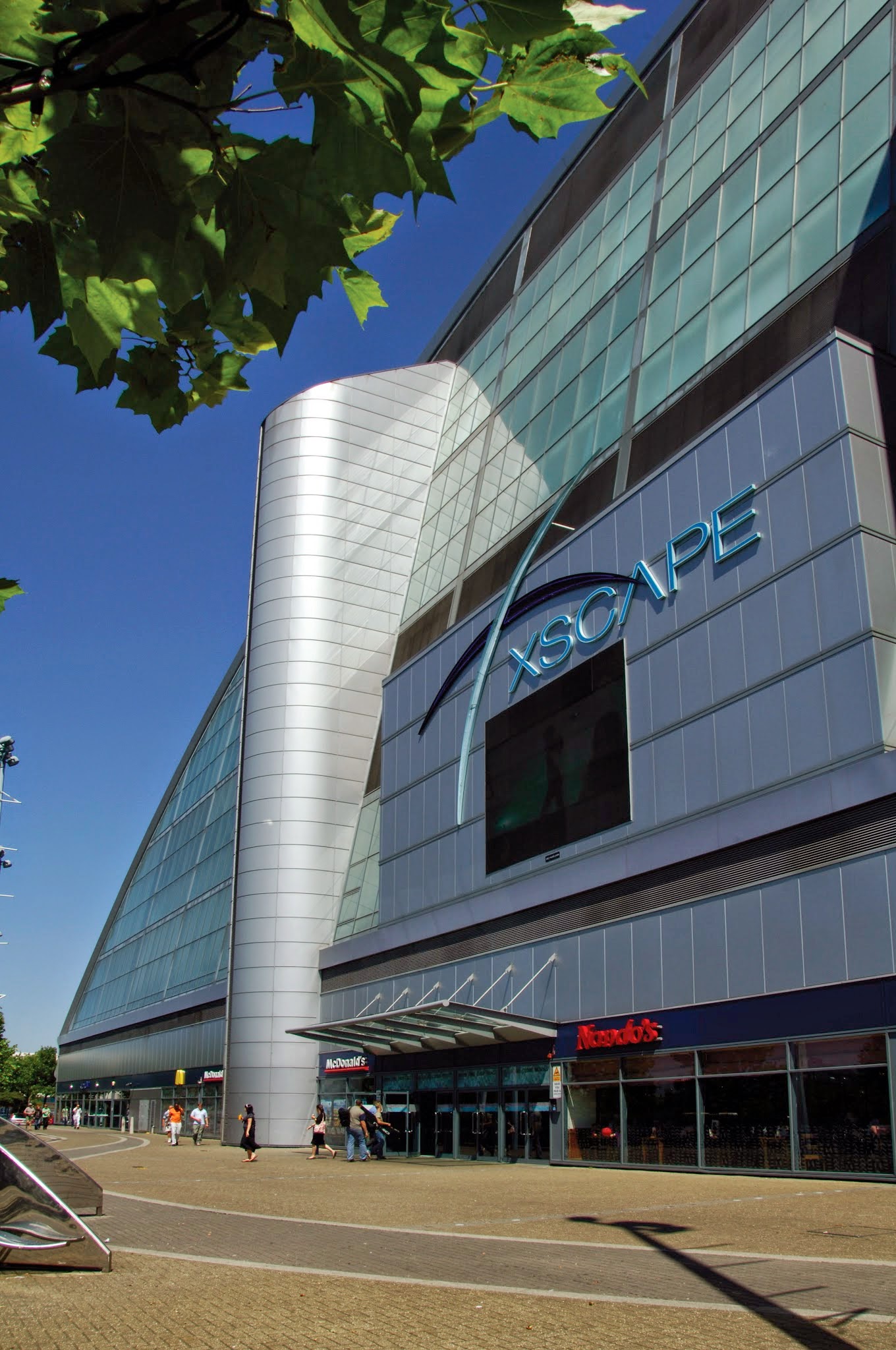
    Leaving the sculpture “Essence”, turn left and go up the pavement outside Saxon Court. This a longish journey, crossing several side roads and going through the Secklow Gate under pass. Now it is a bit tricky as we need to keep running along the pavement until we come to a crossing going towards Wonder World, a shop in the Xscape building. Cross the road and turn right, continuing to the corner of the Xscape complex. Turn left and proceed to the main entrance. The polished stainless steel sculpture called “Xscape” stands out in stark contrast to its surroundings.

    Essence
    Essence

    “Xscape” was created in 2000 by Diane Maclean, who said: ‘The sculpture is a meeting place, a resting place, an amusement – people see their distorted reflections in it (fat or thin) – and the surroundings are reflected like abstract paintings, always changing according to where the viewer is’
    (Historical Notes)

    Now for some fun stuff. Go into the centre and on the left a little way on in a shop, is a climbing wall. If you wish, park and you can watch the climbers attempting to scale the face. After this go to the end of the arcade, turn right and follow the passageway to the Ski Slope. Whilst you can’t get a front row seat, position yourself on the side and you will be able to watch the skiers doing their thing. I sometimes watch with a tinge of envy, but at least I am mobile… Right!

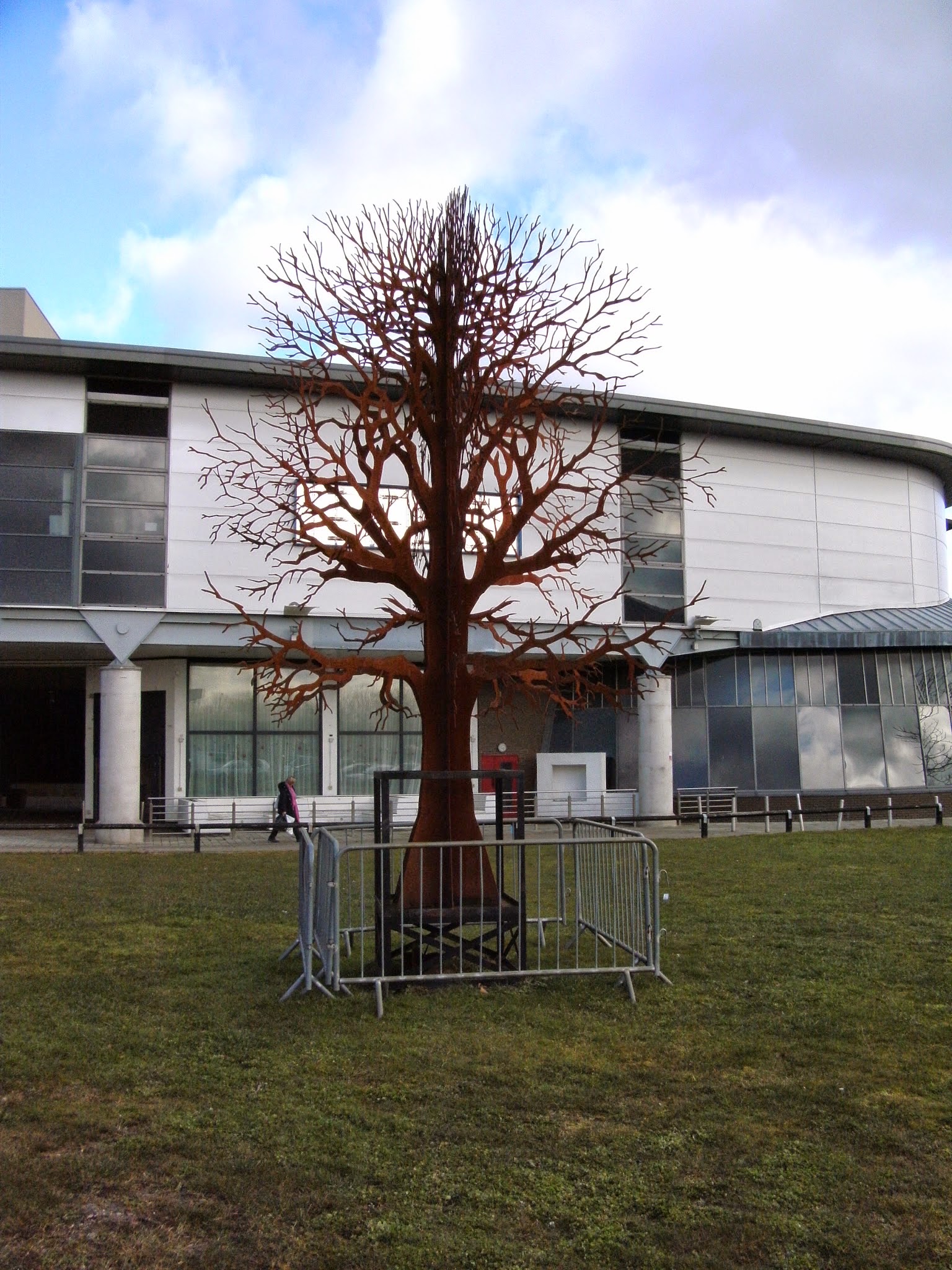
    To progress, backtrack to the arcade intersection and continue out to the pavement. Turn right and at KFC take the crossing to navigate over a side road and Avebury Boulevard arriving in the middle of the “Science Garden”. The whole Garden is comprised of a Cube, Triangles, a Spiral, an Henge and a metal tree sculpture, all the symbols of the basic tenets of science and accepted folklore.

    The “Science Garden” was built to celebrate the 40th Anniversary of the “New City”. At the centre of these installations is a gnomon that casts a shadow to represent both time and space within the historic and scientific context. (Historical Notes)

    Now we go on to locate some nine sculptures in the “Paparazzi” series. It is almost like a hide and seek and a treasure hunt at the same time. At least that’s how it felt when I was looking for them. Turn left at the end of the science garden and then immediately right into lower twelfth street. Stop and look at the domed roof ahead. I can only call this a “pavilion” or a “pergola” which protrudes from the building line. Atop the roof, facing the road, is the first of Stephen Gregory’s sculptures. It is a camera on long vulture legs. It may look inconsequential but it’s significance becomes apparent as we progress.
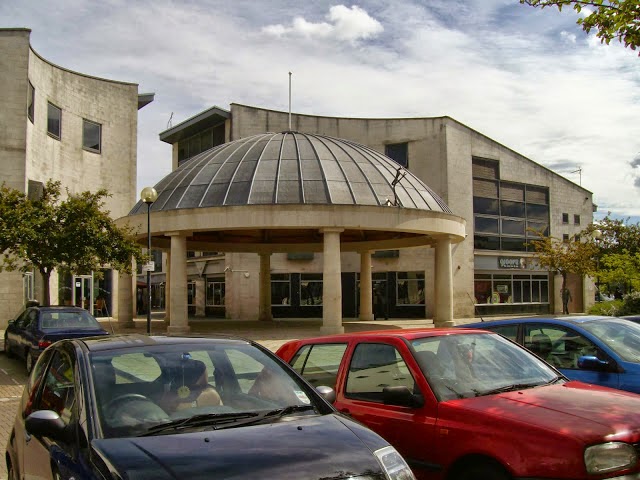
    Paparazzi Camera 1
    Paparazzi Camera 1

    Carry on to the centre of “The Pavilion” and turn right down a passage leading on to a square. Stop at the beginning of the square, turn around and again look up at the roof of the “The Pavilion”. You will notice another two sculptures tracking your progress.
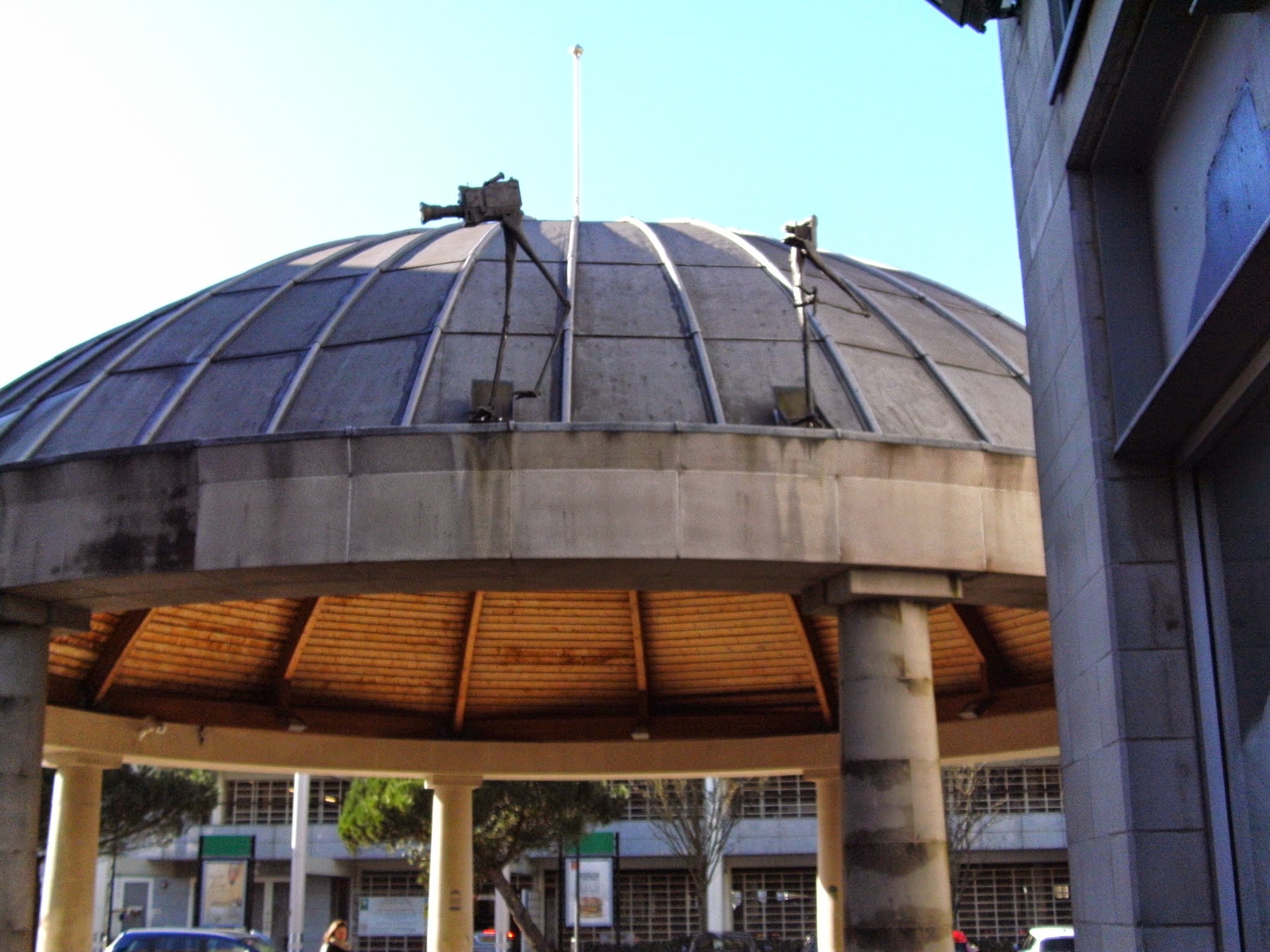
    Paparazzi Camera 2 & 3
    Paparazzi Camera 2 & 3

    Continue to the middle of the square. Stop and look at the roofs of the surrounding buildings in a 360 Degree arc. Spaced evenly are the remaining six sculptures on their Vulture legs, taking in every move you make and stalking your progress, waiting for the right moment to pounce. A detailed analogy of this most fascinating interpretation can be seen on (Historical Notes)

    With no place to hide, we must hurry to the intersection of Savoy Crescent, turn left and make our way towards Midsummer Boulevard.
    Before we reach the road we come across a largish sculpture of two masked people called “Dangerous Liaisons” by Philip Jackson in 1995. They appear to be engrossed and oblivious to their surroundings. Is this from one danger to another?
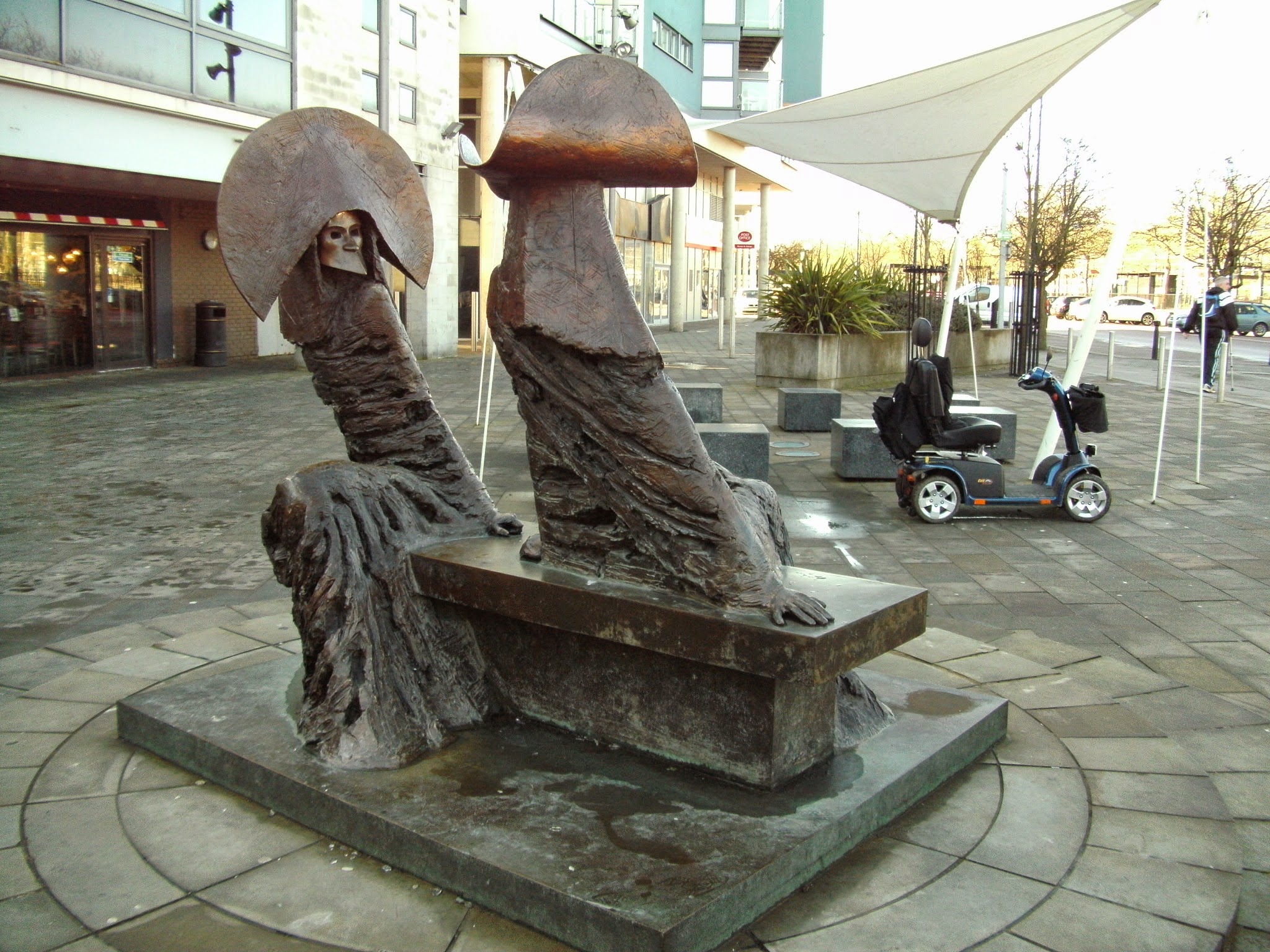
    Dangerous Liaisons
    Dangerous Liaisons

    I think it is symbolism as portrayed in (Historical Notes) , but the conspiracy people believe otherwise. Make up your own mind by going to http://www.mkweb.co.uk/ILLUMINATI-Conspiracy-theorists-claim-Milton/story-24545849-detail/story.html.

    After all this intrigue, time to relax a little, so turn right and a little way on turn right again.This will bring you to the Milton Keynes Theatre. Inside here are three notable pieces, namely “Electric sheep” ,“Wall Work” and “Moon Drawing”. Unfortunately, I was unable to get a reply from Milton Keynes Theatre with regard to my request to publish a picture of these artworks, in spite of several requests.
    To move on and upon exiting the theatre, turn right and you will reach a garden square adorned with polished geometrical shapes, namely pyramids, mounted sloping orbs. a cube, an oval cylinder and a large creeper covered polished stainless steel ball. I’m not sure of the significance of these items other than for decorative purposes. What is pleasing to the eye is a small water course that wends its’ irregular way through this mini open air concourse.
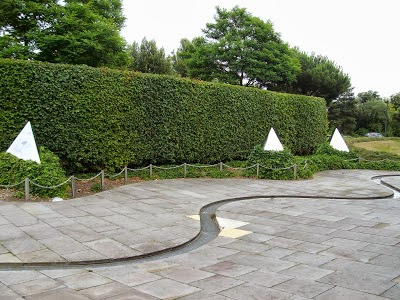
    Polished Geometrical shapes
    Polished Geometrical shapes

    Continue around the building on the left. You need to go a little way to reach level ground. Now do U turn on the pavement go a little way downhill and on the left hand side a grassed area will open up displaying “The Object”  a sculpture by Dhruva Mistry.

    The Object
    The Object

    Dhruva Mistry has created a curious stainless steel architectural structure. Although there seems to be an entrance, physical entry is impossible, and as you move around the sculpture, perspectives seem to distort. See (Historical Notes)

    Continue towards Marlborough Gate. Turn left and take the Midsummer Boulevard underpass. Cross over the coach parking area taking the Silbury Boulevard underpass. Turn left back along Silbury Boulevard and the building on the corner is called John Ormond House.On the building landing stands “The Presentation” by Allan Sly
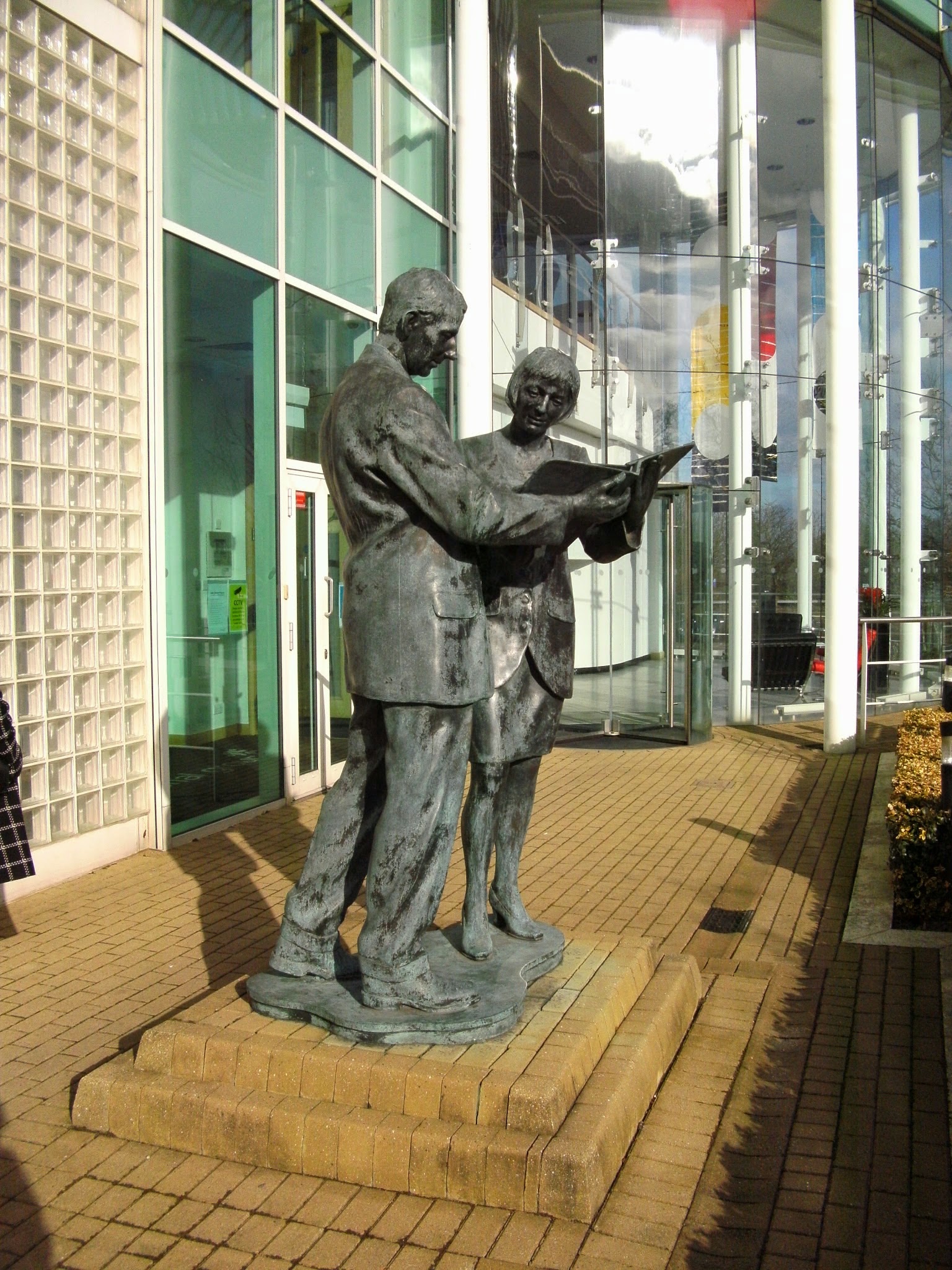
    The Presentation
    The Presentation

    It was commissioned by Personal Assurance as a representation of a symbolic moment in the life of a working team. The company was keen to reflect the loyalty, success and sense of family within the organisation.

    Turn around and backtrack to the corner of the building. Turn left and continue to North Row. Diagonally opposite is a very tall pristine tree circle. To get there you will have to venture on the road. Fortunately it is very quiet here so it is safe enough to navigate.Then, Lo and behold “The Winter Solstice Tree circle” in evergreen splendour.

    Entrance

    The Winter Solstice Tree circle
    The Winter Solstice Tree circle

    I cannot better describe this quiet spot other than to quote Sian and Jackie’s observations :- “The centre of the city contains many items of interest which are not apparent at first sight. The most important of which is a tree circle facing the winter solstice at sunset, as opposed to summer solstice and sun rise. It is a very impressive, tall circle made from conifers which are beautifully kept but has no information board. It is strangely tucked away amongst the car parking where very few people would notice it. One section is cut out and faces west, and so allowing the winter the sun to clearly shine in. We were there just after the winter solstice just before sunset and we can attest that the sun does indeed shine in and fills the entire circle up and is very dramatic”.

    Winter sun shining into Winter Solstice Tree circle
    Winter sun shining into Winter Solstice Tree circle

    Historical Notes and/or Items of Interest : Eastern Section

    It is not always the artefact that impresses but the story allied and/or alluded to it.
    “Xscape”

    Diane Maclean is a sculptor and environmental artist of note and for more information on her variety of activities go to :- http://www.dianemaclean.co.uk/Maclean/

    “Science Garden”

    Businessman and local artist Phillip Pauley created ATOL, which stands for “A Tree Of Life” and is the first in a series of artworks based around the natural world.
    “The metal tree is meant to represent growth and is particularly apt considering the development of Milton Keynes.”

    “Paparazzi”

    The best rationale I have found is explained in the following detail.

    “Groups are seldom benign, whether massed people, flocks of birds or herds of animals – there is always an element of unease and unpredictability about them.. This parade of anthropomorphic cameras gives rise to feelings of revulsion, horror and humour. The cameras on vultures’ legs tell us that they prey on their victims – such images surely inhabit the nightmares of most members of the glitterati. The menacing stance of these creatures, their undeniably black patina giving character to their black souls, is intensified by their group presence. Hunting in a pack, they survive, but ultimately this is the survival of the fittest as they seemingly jostle for position to get the best shot.

    Gregory collected ancient stills cameras and a movie camera, finding them in antique markets and second-hand shops, and used them to create different characters within this group. Their individuality is emphasised in different ways: the bellows in one, the placing of the camera vertically or horizontally in others. After all, we are all unique. The smallest of these dark beings sneaks to the fore to gain a better view, the extended claw of one towards the rear menaces both his colleagues and their prey. The glistening eyes of the lenses, their penetrating collective eye, serve to emphasise their intent, and are a subtle but essential touch in this assembly.

    Is this a severe case of media bashing? Possibly. More likely a wry look at a phenomenon of the late twentieth century, a marked sign of our times.”
    With acknowledgements to the Cass Sculpture foundation:-http://www.sculpture.org.uk/sculpture/473/paparazzi

    “Dangerous Liaisons”

    Philip Jackson CVO DL MA FRBS is a renowned sculptor with an outstanding international reputation His ability to convey the human condition through skillful use of body language is legendary, producing figures both imposing and operatic in their narrative and presence, which are recognisable worldwide.Philip Jackson has undertaken many public and private commissions, including sculptural portraits of Dame Felicity Lott and Baroness Thatcher.
    http://www.philipjacksonsculptures.co.uk/

    “Dangerous Liaisons” is one of a series of sculptures by Philip Jackson based on the mask and inspired by the Maschera Nobile of 17th and 18th century Venice. This elegant costume hid the identity and gender of its wearer, allowing him or her to go about the city unrecognised, and enabling intrigues, vendettas and love affairs to take place without fear of discovery. Jackson describes his work as ‘a sculpture about body language and the interaction between two people. It portrays two people sitting on a bench in deep conversation. One is discernibly male, the other discernibly female, although this is understood only by gesture and pose. They take no account of the viewer; their concentration is on each other. The viewer, however, must determine what secrets are flowing between them – what dangerous liaison is taking place.

    Comments from david icke.com

    “The Object”

    The Object was developed from earlier works by Dhruva Mistry in which he combined images of the human figure with geometric forms, or used an object – such as a chair – to represent human presence. In this work he has created a curious architectural structure of planes, crystalline forms and cut-outs, which alludes to fairytale palaces and dream castles. Although there seems to be an entrance, physical entry is impossible. As the viewer moves around the sculpture, perspectives distort and expectations are confounded, in the same way as space is contorted in an Escher drawing. Dhruva Mistry was born and studied in India, coming to England in his early twenties to further his career as a sculptor. His work combines the rich imagery and narrative of Indian art with influences of Western sculptural traditions.

    “The Winter Solstice Tree circle”

    Sian and Jackie have some interesting observations on their Blogspot which can be accessed on
    http://sianandjackie.blogspot.co.uk/
    Acknowledgements to Sian and Jackie for use of their pictures of the “Pergola”, Winter sun shining into Winter Solstice Tree circle and the meandering water course near the MK Theatre.
  • City Centre 2 ( The Central Scenic Art Trail )

    City Centre 2 ( The Central Scenic Art Trail )

    Midsummerplace

    The City of Milton Keynes (Part Two Central Section)

    Si monumentum requiris circumspice. ( If you seek a monument, look about you )

    Central Section covers From the Milton Keynes Saxon Gate (V7) up to Secklow Gate

    Just a reminder, as a word of caution, when navigating through the city centre, always proceed alongside buildings. Sometimes following a pavement in a parking area leads to dead ends or long drops which don’t do much good to most mobility scooters.

    A map of centre of the centre is recommended and this can be obtained from the information desk in the centre, which is just on the left of the intersection of Deer Walk and Silbury Arcade.This happens to be on our route later on in this ramble. Alternatively it can be down loaded from the web.
    I also want to point out that the photographs in this ramble are not cropped to be perfect, but so as to give a sense of naturalness.

    Now we continue our journey by crossing under Saxon Gate on Silbury Boulevard and the first building one sees is the Council Office Block. In the stairwell there are two paintings, acrylic on canvas, by Stephen Gregory, who was an artist in residence in Milton Keynes between 1977 and 1979.

    They are known as “Catwalk and City Centre 1” and they examine the building of the new town and celebrate its contemporary architecture. (See Historical Notes and Items of Interest).

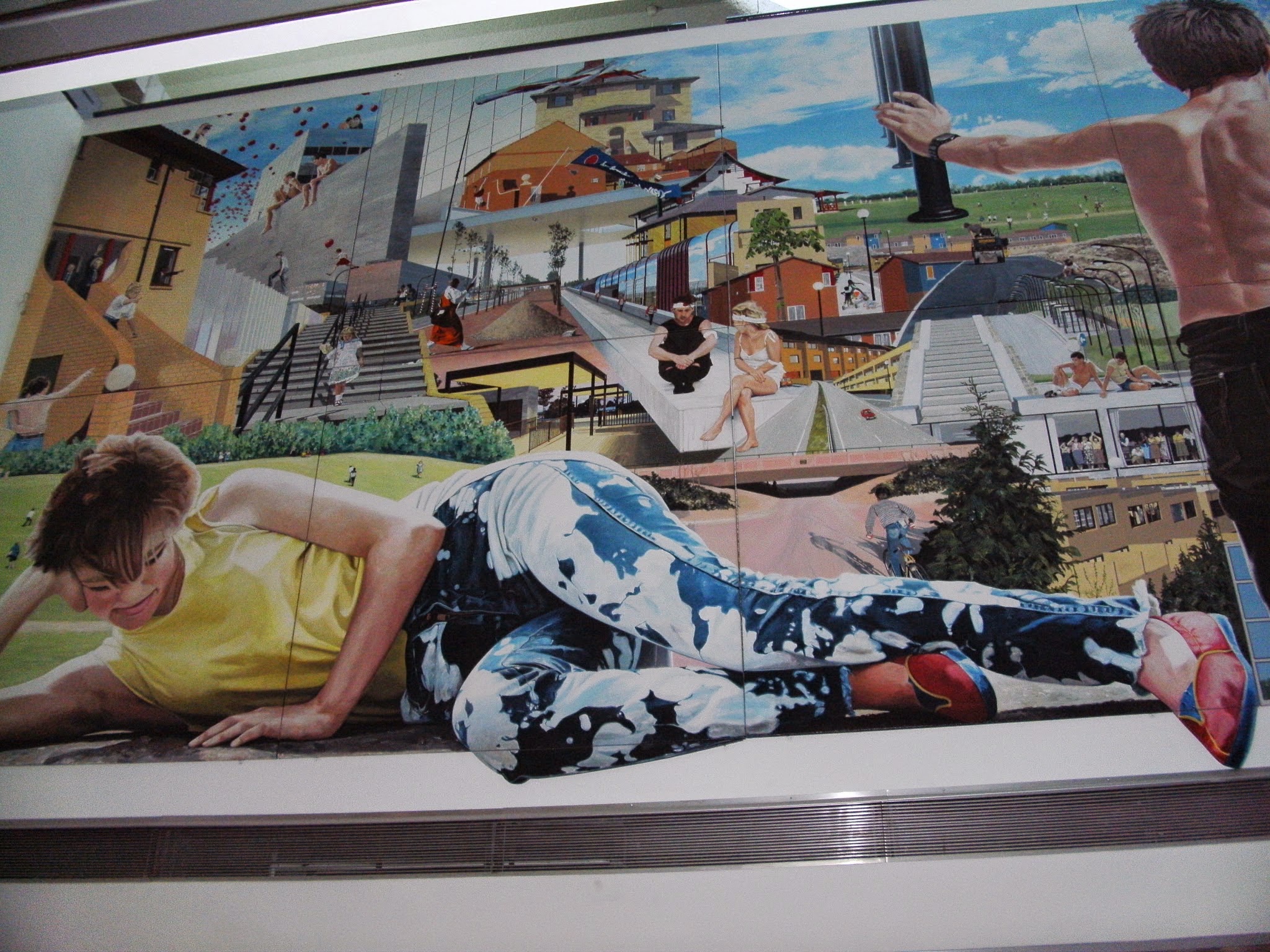
    Still on Silbury Boulevard, cross over North 8th Street to the Library. Take the lift to the floor above and overlook the stairwell. There hangs an acrylic on canvas painting called “Someday” and were created by Fionnuala Boyd and Les Evans in 1984.

    Someday
    Someday

    “Someday” shows scenes from life in the ‘new town’ of Milton Keynes.
    In 1982, Fionnuala Boyd and Les Evans were invited to Milton Keynes as artists in residence.They have lived and worked in the city ever since.

    Take the lift back down to ground floor and go to the stairwell. There suspended is the painting, also by Fionnuala Boyd and Les Evans, called “Fiction, Non Fiction & Reference”.

    This large scale painting draws its reference from hundreds of documentary photographs of Milton Keynes and shows local estates and local people.Its title refers both to a book section of a public library and to the content of the work, which mixes fictional and real events.

    The shear size of “Fiction, Non Fiction & Reference” is very impressive and awe inspiring.For further information about the artists see ( Historical Notes and Items of Interest)

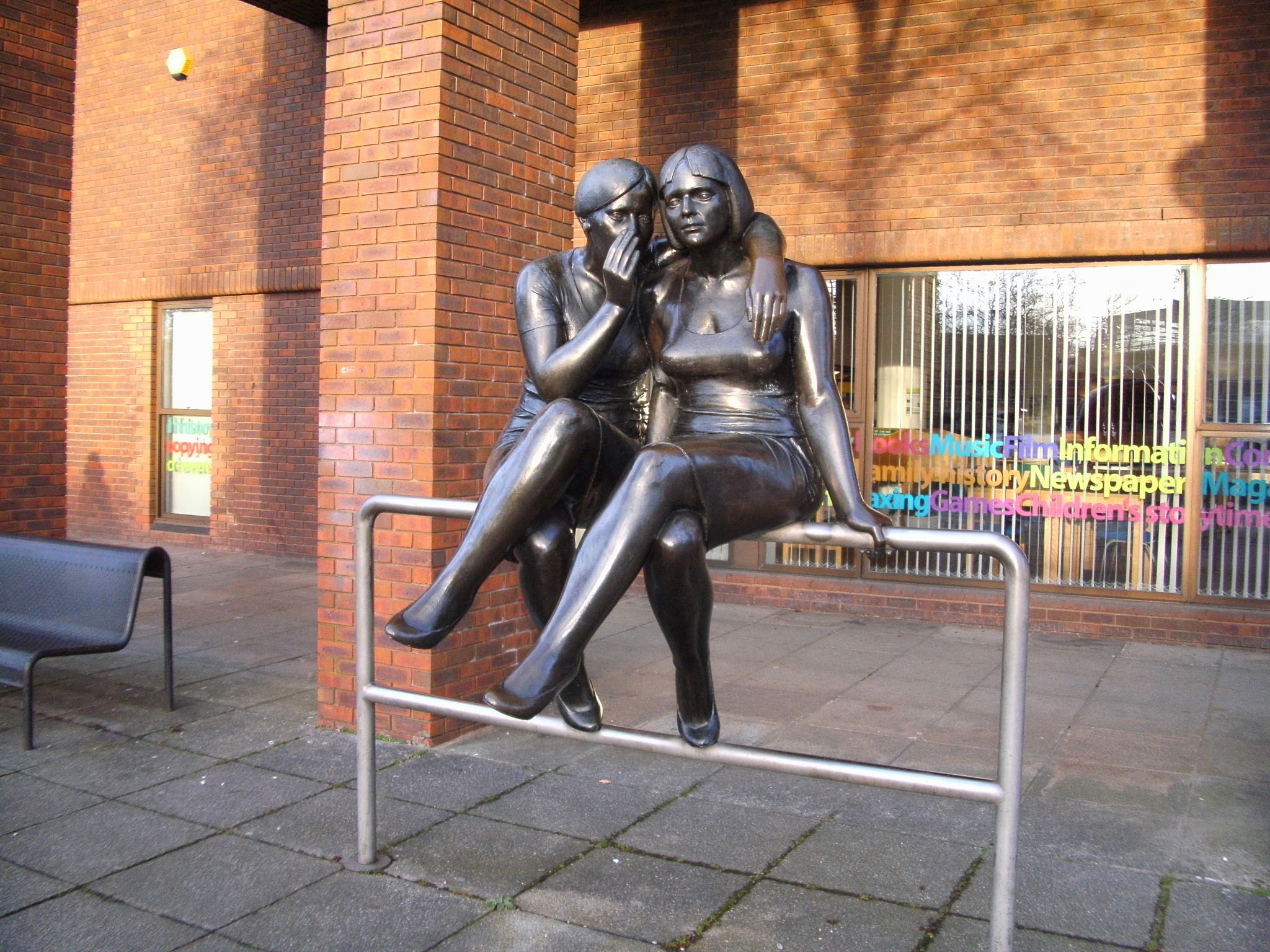
    Exit the library turning left and immediately one is confronted by the sculpture “The Whisper” by Andre Wallace in 1984.

    The Whisper
    The Whisper

    “The Whisper” is ideally suited to be outside the public library, a space where people meet and socialise. Wallace’s distinctive heavy figures, larger than life size, sit relaxed and at ease, watching the world go by.For more info see ( Historical Notes and Items of Interest)

    Now to move on to an insignificant feature with a highly significant history. Turn left down North 9th Street and continue to North row. On the corner a grass mound appears with three large trees surrounded by shrubbery. This is the only historic site in the city centre and is known as Secklow meeting mound.
    Most people walk straight past and do not know it’s real historical significance. In appearance it is just another mound with grass on it. However there is a plaque which explains its yesteryear importance.

    Secklow meeting mound
     Secklow meeting mound.

    In 1978 The moot mound of the Secklow Hundred was found, excavated and reconstructed, prior to it being overlain with the development of central Milton Keynes. It is on the highest point in the central area.(See Historical Notes and Items of Interest)

    Across the road we can see the MOTH (Memorable Order of Tin Hats) memorial where each year members assemble and lay a wreaths for their comrades.

    MOTH memorial
    MOTH  memorial

    This order was founded in South Africa but has branches called shellholes in the UK.
    The only local reference of note that I can glean, is an article by the Citizen published on the 22nd September 2003. For this and some MOTH history, See Historical Notes and Items of Interest.

    Continue along North Row in an easterly direction and after two blocks the Row veers right. Follow this direction which heads back to Silbury Boulevard. On the corner is a plinth with “The Black Horse” on it.This picture was taken after someone decided to make him more colourful.

    The Black Horse
    The Black Horse

    “The Black Horse” a bronze sculpture by Elizabeth Frink in 1978, is sited outside Lloyds Bank, echoing its iconic logo. Elizabeth Frink gained recognition in the early 1950s. She used animal and human forms to express the anguish of the post war period.(See Historical Notes and Items of Interest)

    Time now to move on into the centre’s main shopping mall. A plethora of shops, restaurants and a few open air spaces and enclosed/halls are set out to attract the most discerning of shoppers. It is very Mobility Scooter friendly with abundant space in its wide walkways.

    Inside MK Shopping Centre
    Inside MK Shopping Centre

    Turn left on silbury Boulevard and just a short way along the underpass of Seclow Gate turn right and head over the access roads to the entrance of the shopping centre called Deer Walk. On entering the mall,look to the left and mounted on the wall are the remains of one the Roman Mosaics recovered from the Roman Villa in Bancroft.

    Roman Mosaics
    Roman Mosaics

    The history of this Roman villa is covered in another ramble encompassing Bancroft, which is penned in for future construction.

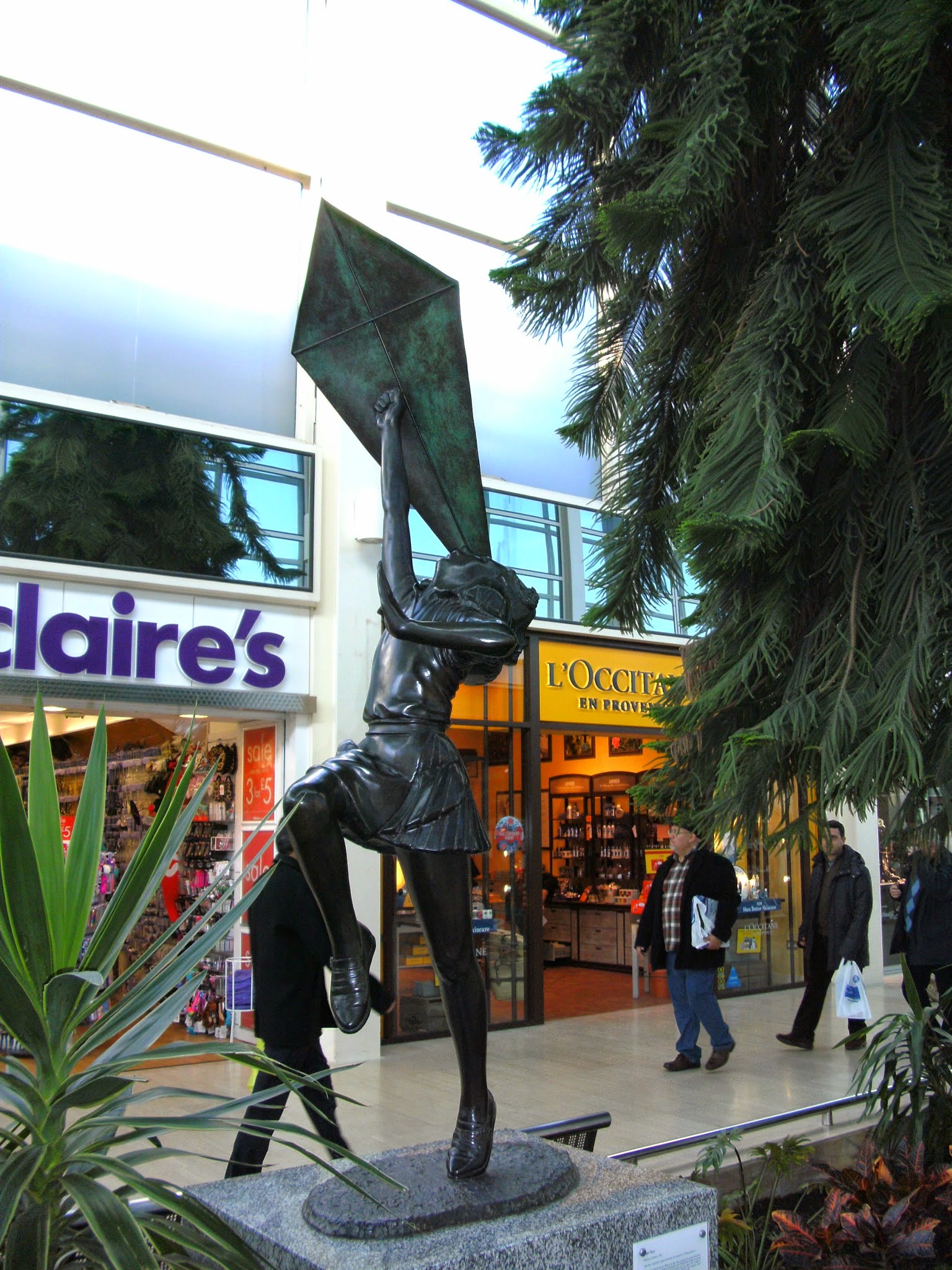
    Carry on and turn right at the intersection on Silbury Arcade and proceed down the left-hand walkway. Cross over Crown Walk and over Borough Walk. On the left is Cafe Rouge and on the right in the centre jardiniere pot is the sculpture called “Flying Carpet”. This was sculptured by Philomena Davis and was completed in 1989

    Flying Carpet
    Flying Carpet

    Continue in the same direction and a little further on and in another centre jardiniere outside The White Company, “High Flyer” is situated.This was also sculptured by Philomena Davis and was also completed in 1989
    .

    High Flyer
    High Flyer

    Once again continue in the same direction and in the centre jardiniere outside Patisserie Valerie, “Dream Flight” is sited.

    Dream Flight
    Dream Flight

    Thisagain was sculptured by Philomena Davis and completed in 1989 and is the last in the series. These sculptures focus on the theme of flight. The artist describes as follows:- ‘they depict man’s fantasy with flight and escapism, in particular, the sorts of escapist dreams that come to us in childhood and adolescence’. (See Historical Notes and Items of Interest)

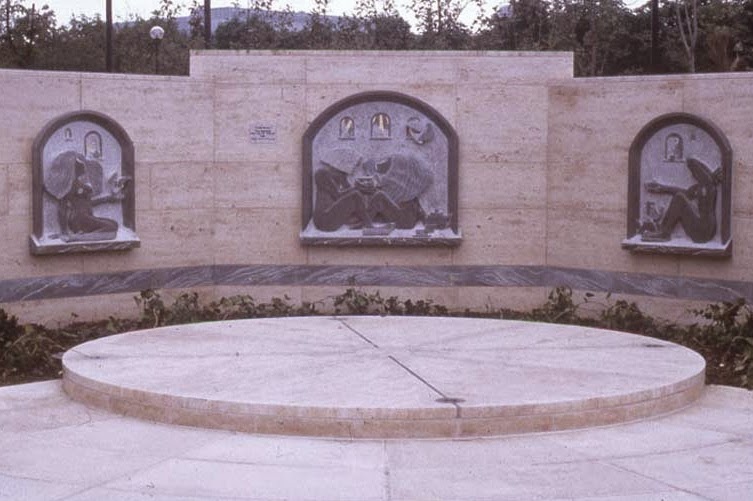
    Now we carry on in the same direction but this time we leave the mall and enter City square, where sunken in the corner, there appears to be a quarter circle amphitheatre with descending seating overlooking three panels called “The Meetimg” by Nicholas Moreton.

    The Meetimg
    The Meetimg

    “The Meeting” was made from Birds eye Derbyshire fossil limestone and bronze in 1995.
    The outer panels Dawn and Reflection shows a man and woman separately contemplating
    the day’s events. The Cup (middle panel) is described by the artist as showing ‘a man
    and woman sharing thoughts and wishes, symbolised by the sharing of a drink from the
    same cup’.(See Historical Notes and Items of Interest)

    Turning to the right a Sculpture on a plinth named “The Conversation” (also by Nicholas Moreton.) over looks the square.

    The Conversation
    The Conversation

    “The Conversation” was made from Kilkenny black fossil limestone and bronze in 1995
    and consists of two figures in conversation, raised from the ground on a plinth, away from the bustle of the people below. The plinth is their table, an intimate and private space elevated above the rest of the world.(See Historical Notes and Items of Interest)

    OK, time to backtrack into the mall the way we came out. On entering, turn right along Sunset walk and exit the mall and enter Midsummer Place. You will come to Oak Court which is a circle of shops around a sunken area where the well known “Concrete Cows” are grazing happily.

    Concrete Cows
    Concrete Cows

    The original “Concrete Cows” were made in 1978 by US artist Liz Leyh with the help of local schoolchildren. The cows have been relocated around the city including the Hockey Stadium in 2007 where they became a mascot of MK Dons. They are currently corralled around the oak tree located in Oak Court, whilst a set of replica cows is at Bancroft and another replica set is in Interchange Park Newport Pagnell. (See Historical Notes and Items of Interest)

    Within the corral to the right of the above picture there is a stainless steel sculpture of “Acorns and Leaves”

    Acorns and Leaves
    Acorns and Leaves

    Tim Ward’s sculpture of “Acorns and Leaves” relate to the location under the old oak tree in the middle of the Midsummer Place shopping centre, (See Historical Notes and Items of Interest)

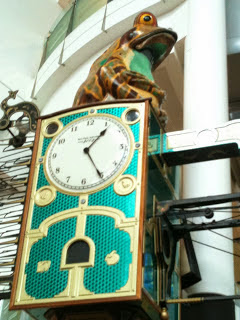
    Continuing along West Walk this veers left into the south concourse.In the centre on the left the “Frog Clock” leaps into view.

    Frog Clock
    Frog Clock

    The “Frog Clock” Designed and created by the famous Kit Williams, The “Frog Clock” arrived at Midsummer Place Shopping Centre in 2002 where it has since attracted thousands of children and adults visiting the centre each week.
    Try to time your visit as it performs on the hour, and is very popular with families, as the performance includes music and culminates in the frog blowing bubbles onto the crowd below. The clock weighs 4 tonnes, and is believed to be one of Britain’s biggest animated feature clocks.(See Historical Notes and Items of Interest)

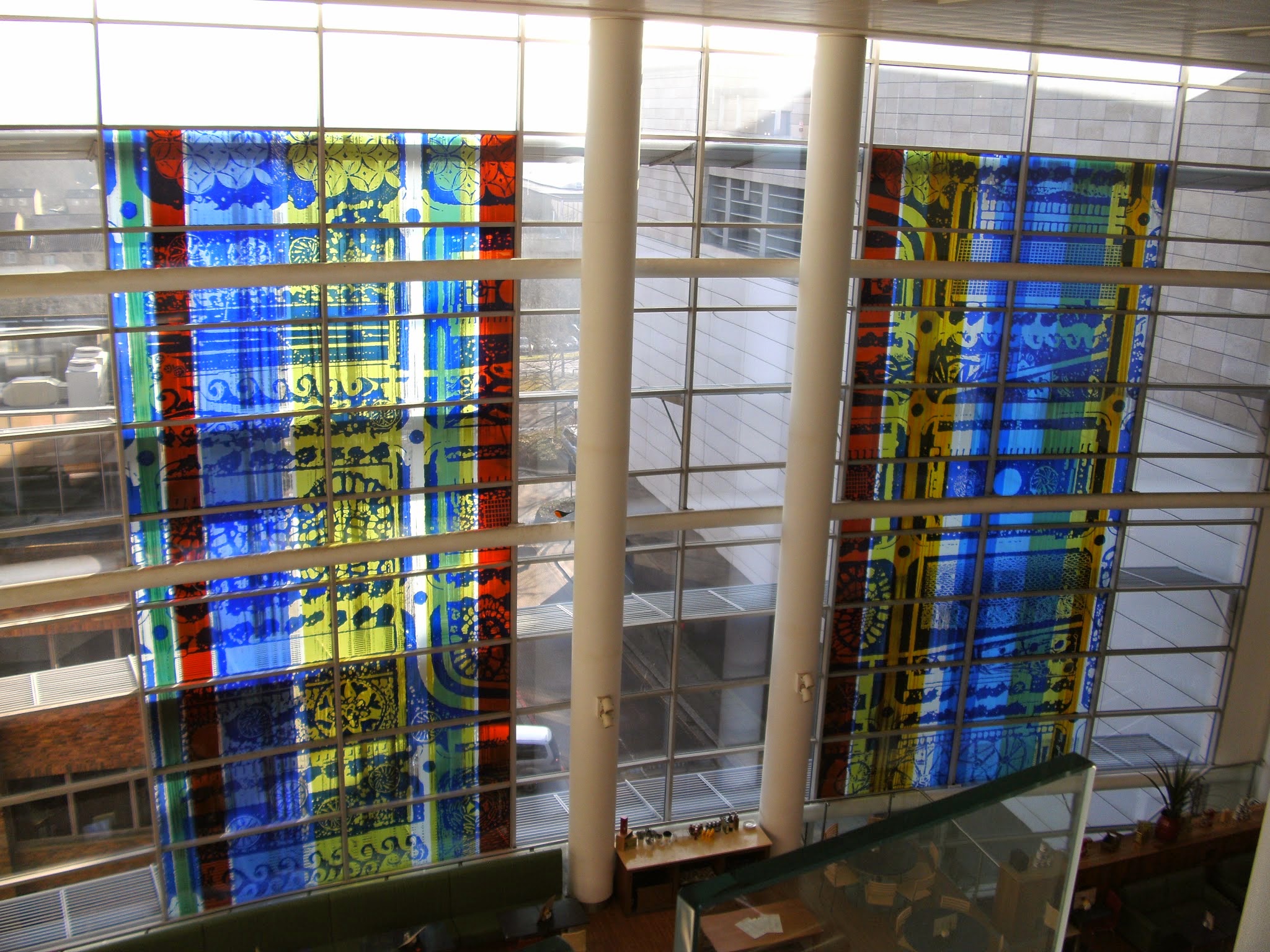
    Stay where you are because the “Midsummer Place Glass” by Anne Smyth is directly opposite the clock above the coffee shop.I strongly suggest you take the lift up to the second or third floor and view the glass window from there. This really gives a perspective of its size and amount of work that was required to produce it.

    Midsummer Place Glass
    Midsummer Place Glass

    This enormous glass was made from coloured, carved and etched glass.When the sun shines, coloured light floods into the shopping area. Designed around Milton Keynes’ geometric grid system, using the architect’s original road models for reference. Woven into the grid are images of historical and current activity such as the geometric patterns from the Roman Mosaic found at Bancroft. Enigma from Bletchley Park, train wheels from Wolverton and the Grand Union Canal.(See Historical Notes and Items of Interest)

    Now head on around the corner into East Walk and on reaching the open food square, look on the right hand side. There outside Waterstones is “Sitting on History”, a bronze sculpture by Bill Woodrow in 1996

    Sitting on History
    Sitting on History

    The ball and chain refers to the book as ‘captor of information’ from which we cannot escape. Woodrow proposes that although we absorb knowledge from history, it doesn’t necessarily change our behaviour.(See Historical Notes and Items of Interest)

    Continue in the same direction out of Midsummer Place and returning to the Centre shopping mall. At the first intersection, turn right and proceed down along Midsummer arcade in the left hand walkway. On reaching an open area called Queens Court and in the right hand corner, you will find a sculpture called “Vox Pop”. It is a delightful bronze rendition of the Family by John Clinch in 1988.
    (See Historical Notes and Items of Interest)

    Vox Pop
    Vox Pop

    A shortened form of ‘vox populi’ a Latin phrase meaning the voice of the people. Clinch’s work celebrates ordinary members of the public rather than the rich and famous.His multi-racial ‘family’ walk a dog, cycle and push a baby buggy following a circular path, encouraging visitors to walk round them and examine the detail of the sculpture. The sculpture was originally intended to show the diversity of people needed to make Milton Keynes a great city.

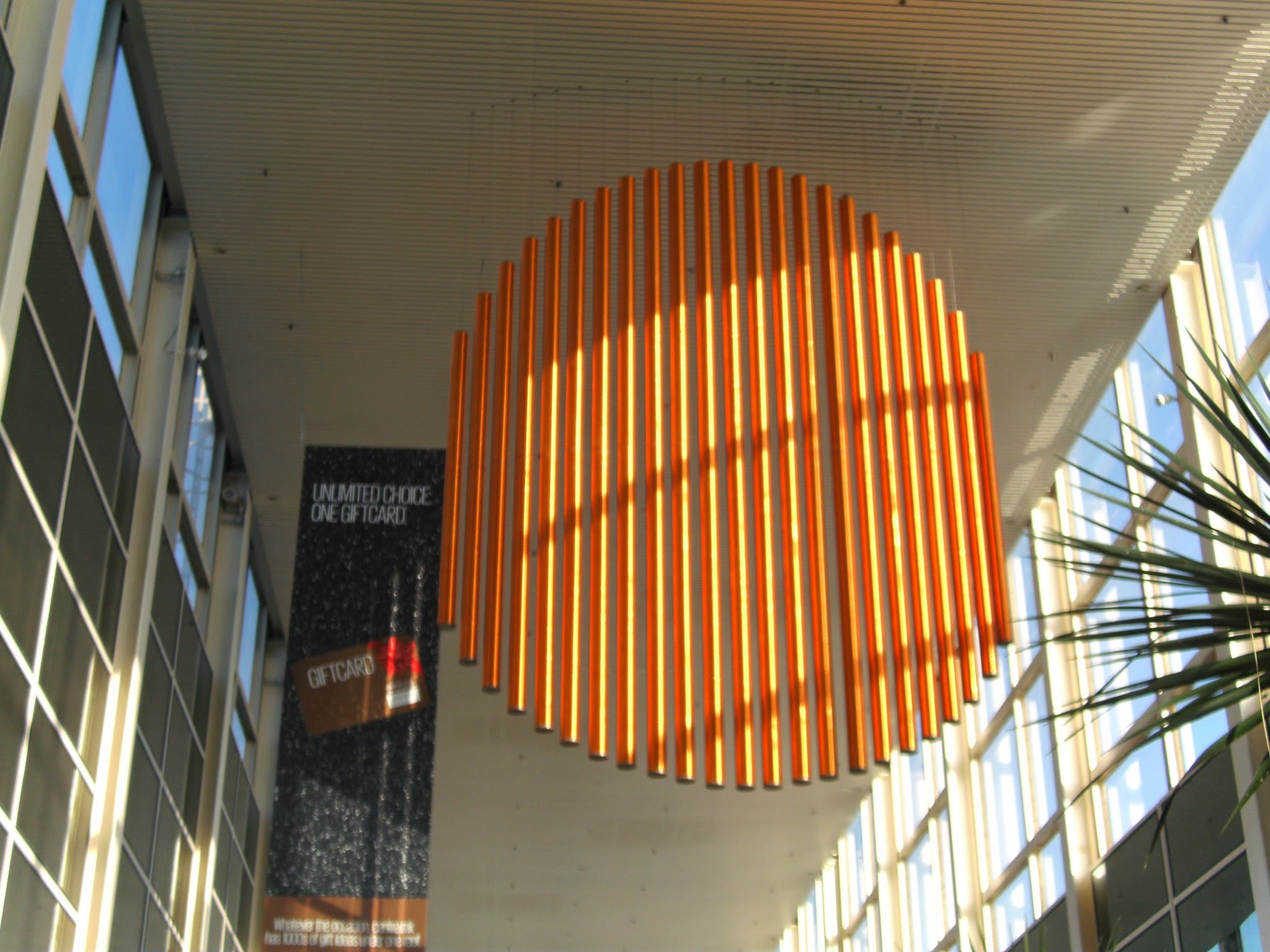
    Proceed in the same direction along Midsummer arcade in the left hand walkway until the intersection with Crown Walk. Stop and look skywards and “Circle of Light”will loom large into your view.

    Circle of Light
    Circle of Light

    The 1980 creation of aluminium and copper wire by Liliane Lijn is very impressive indeed.
    “Circle of Light” consists of 23 tubes creating a curved, circular plane that relate to the shape of the sun, moon and human eye. The cylindrical tubes relate to the shapes behind the retina of the eye that convert light into electrical pulses.(See Historical Notes and Items of Interest)

    Now we go a short distance along Crown Walk to the exit of the Centre in the direction of Midsummer Boulevard. Turn left on the pavement and about three to four shops along, look to your right and you can’t miss “A Mighty Blow for Freedom**** the Media”,Standing bold and aloof in the middle of the open square just before the maze of Market Stalls. This 1988 bronze sculpture portrays the feeling of Michael Sandle.

    A Mighty Blow for Freedom**** the Media
    A Mighty Blow for Freedom**** the Media

    Michael Sandle’s work is a critique of the media, taking the logo of a well-known film company as its starting point. The strong-armed man striking a gong in the logo is replaced by a helmeted androgynous figure swinging an axe to smash a television.(See Historical Notes and Items of Interest)

    And now to the last artifact. Go back along the pavement and continue between Midsummer Place and the Centre until reaching the cycle redway just before Saxon Gate. Turn left and follow this redway through the Avebury Boulevard underpass. On emerging this underpass, the first thing seen is the sculpture “Essence” on a marble plinth.

    Essence
    Essence

    Aptly, we finish this Central ramble with another Wendy Taylor bronze sculpture completed in 1982.
    The artist describes her work as being ‘surrounded by a wide selection of shrubs which give a secret air to the area, providing a complete contrast to the bold outlines of Milton Keynes’ avenues. The soft enfolding lines of the sculpture are a response to the intimacy of the enclosed environment.’ (See Historical Notes and Items of Interest)

    There is another item of interest not in the itinerary, which is an unusual mechanical clock that stands about 5 metre high. It is sited in Midsummer arcade next to the open air market.

    Mechanical clock
    Mechanical clock

    Historical Notes and Items of Interest : Central Section

    It is not always the artifact that impresses but the story allied and/or alluded to it.

    “Catwalk and City Centre 1”

    For further information on Stephen Gregory go to :- http://www.bbc.co.uk/arts/yourpaintings/paintings/search/painted_by/stephen-gregory_artists

    “Someday”, “Fiction, Non Fiction & Reference”
    The team ofFionnuala Boyd and Les Evans After meeting as students at St Albans Art School in the late 1960s, Fionnuala Boyd and Leslie Evans married and began to work collaboratively. For further interesting information go to :-
    http://www.artfortune.com/fionnuala-boyd/artistbiographies-129488/

    “The Whisper”

    One of the most expressive sculptures in Milton Keynes. It is graphic, poignant and certainly eye catching. For more about Andre Wallace and other works go to :-
    http://www.andre-wallace.co.uk/public-commissions

    Secklow Meeting Mound

    “Secklow Hundred” is an ancient ‘Moot Hill’ in Milton Keynes.
    A Moot hill is a hill or mound historically used as a meeting place. In early medieval Britain, such hills were used for moots, meetings of local people to settle local business. Among other things, proclamations might be read; decisions might be taken; court cases might be settled at a moot. Although some moot hills were naturally occurring features or had been created long before as burial mounds, others were purpose-built. During the Roman reign, transport links improved, and so more settlers gradually migrated to this area from around 500 AD.
    The Angles, Saxons and Danes were the largest groups, establishing themselves in such places as Caldecotte, Wolverton, Bancroft, Bradwell, the Shenleys, Wavendon Gate, Pennyland and Great Linford. Boundaries around the manors developed into parish boundaries and these were grouped into ‘Hundreds’ for administrative purposes; the Bunsty, Moulsoe, and Secklow Hundreds. Meeting places were built as mounds where these boundaries met, and the Secklow Hundred Meeting mound can still be seen behind the City library where it was used up to the 13th century. For more about meeting grounds go to :- http://www.archaeologyuk.org/ba/ba120/feat6.shtml

    MOTH Memorial

    Citizen extract

    MOTHS have gathered again in Milton Keynes.

    Ex-servicemen and women of the Memorable Order of Tin Hats assembled at the official memorial in the city centre for their annual service.

    The day saw former members of all forces since World War 2 travel from all over the country to meet and salute their comrades.

    This year was particularly special as it’s the 21st anniversary of the memorial being established in the city.

    The chaplain to the Royal British Legion the Rev Kevin McGarahan conducted the service, which was followed by a march past and salute.

    The MOTHS are seeking new members. If you are interested then please call Terry Goddard on MK 227994.

    Orther useful sites are https://en.wikipedia.org/wiki/Memorable_Order_of_Tin_Hats  and www.moth.org.za/

    “The Black Horse”

    Dame Elisabeth Frink is internationally recognised as a major 20th century British Sculptor Her sculptures embody the great themes that she explored throughout her career: The ambiguities of human relationships, injustice and impermanence that also have such impact on the animal world and the earth. Using the form of men, animals and birds, she employed their shapes as vehicles to convey emotion, vulnerability and aggression. To find out more about this talented artist go to :- http://www.elisabethfrink-estate.com/

    “Flying Carpet”, “High Flyer” and “Dream Flight”
    Philomena Davis (AKA Philomena Davis Davidson) was elected the first woman President of the Royal Society of British Sculptors in 1990. For further interesting details go to :-
    http://www.rwa.org.uk/rwa-artists/academicians-listings/d/davidson-davis-philomena/

    “The Meetimg” and “The Conversation”
    To find out more about another talented artist and his works, namely Nicholas Moreton, go to :-
    www.nicolasmoreton.com/sculpture/commissions/

    “Concrete Cows”

    Milton Keynes has become famous if not infamous for the replica concrete cows that live in a field in Bancroft. Like much of the New City the concrete cows have now acquired a history of their own.

    They were made by Liz Leyh, a Canadian born artist/sculptor at Stacey Hill Farm, now the home of Milton Keynes Museum, when the farmhouse was used by various artists and writers in residence who were employed by Milton Keynes Development Corporation.

    During their lifetime the cows have lead a rather adventurous lifestyle, kidnapped and held to ransom on occasion, placed in somewhat compromising poses, not to mention the occasional wanton vandalism and periodic repainting. They have often featured as headline news to the national media, keen to brand the city with a rather quirky image. Today they graze in peace close to the place of their birth, in relative anonymity apart from the occasional glance from the passing motorists.

    Over the years a number of unfortunate things have happened to the cows, they have been stolen, had ‘pyjamas’ painted on them, BSE graffiti and Lesley has even had to rebuild them after they were beheaded.

    The cows continue to be visited by dog walkers and passers by and attract the constant amount of attention they deserve. It seems that all children that visit cannot resist climbing on these lovable friends to Milton Keynes.

    “Acorns and Leaves”

    For more on Tim Ward go to :- http://www.artworkersguild.org/member/timward/

    “Frog Clock”

    The man behind this fantasia project is Christopher ‘Kit’ Williams (born 28 April 1946 in Kent, England) who is an English artist, illustrator and author. For more about this and other works,see more detail on en.wikipedia.org/wiki/Kit_Williams

    “Midsummer Place Glass”

    Anne Smyth is a decorative artist, who works mainly with glass and other architectural materials.
    An interesting guide to her and her projects can be found on http://www.annesmyth.com/index.html

    “Sitting on History”

    ‘Sitting on History’ was proposed in response to a commission first discussed in 1990 and to Woodrow’s Tate Gallery exhibition in 1996, which gave him the opportunity to realise a sculpture which could function as a seat.

    Woodrow had made three Marquette based on a book form: one with coins as the seat backs, another featuring two crows on the spine of the book fighting over a gold coin and this version, entitled ‘Sitting on History’. Woodrow’s idea was to have a sculpture that was only completed conceptually and formally when a person sat on it.

    ‘Sitting on History,’ with its ball and chain, refers to the book as a receptacle of information. History is filtered through millions of pages of writing, making the book the major vehicle for research and study. Woodrow proposes that although one absorbs knowledge, one appears to have great difficulty in changing one’s behaviour as a result.

    The real books from which the original Marquette were made came from a box of books given to Bill Woodrow by a London bookseller, discarded, as they were no longer saleable. To Woodrow’s wry amusement, in this haul were three volumes on the history of the Labour Party, which he chose to use for the Marquette. Woodrow finds books one of the most powerful democratic tools in the world and still the most advanced form of communication.

    “Vox Pop”

    An obituary for John Clinch aptly describes him and his works and can be found at http://www.theguardian.com/news/2001/apr/14/guardianobituaries1

    “Circle of Light”

    One of the many fantastic works by kinetic artist Liliane Lijn. Her illustrious and artistically adventurous life so far, can be followed on this link ;- http://www.lilianelijn.com/archive/cir01.html

    “A Mighty Blow for Freedom**** the Media”

    The multi talented Michael Sandle RA (born 18 May 1936) is a British sculptor and artist, “widely recognised as one of the finest sculptors in the world”. His works include several public sculptures, many relating to themes of war, death or destruction. His work has been critical of what he describes as the “heroic decadence” of capitalism and its involvement in global conflict. For more on his life see http://en.wikipedia.org/wiki/Michael_Sandle.

    “Essence”

    There are some exciting sculptures on the Wendy Taylor website.This website showcases the impressive range of large-scale, site specific sculptures, such as the well known Timepiece at Tower Bridge To learn about Wendy go to wendytaylorsculpture.co.uk/

    This completes the central section and the final Eastern section which is under construction will be published in due course which, is hopefully shortly.

  • City Centre 1 ( The Western Scenic Art Trail )

    City Centre 1 ( The Western Scenic Art Trail )

    City Centre view

    The Inner City of Milton Keynes (Part One Western section)

    Si monumentum requiris circumspice. ( If you seek a monument, look about you )
    To paraphrase the famous quote ” All roads lead to Rome “….In Milton Keynes’ case all Redways lead to the City Central…Our founding fathers specifically designed 360 degree access by creating designated cycle routes. These utilise underpasses and overpasses to avoid main thoroughfares. This facilitates safe passage to, from and in the very heart of this great “city”. I say “city” but in reality, Milton Keynes is officially a town, but nevertheless, to its proud residents, it is regarded as a city.
    To follow my Redway journey, a big help would be a Milton Keynes Redway Guide, which is available in a handy pocket size from the Council Offices, The Parks Trust and many local cycle shops and hotels, or you can download your map from the web. As a word of caution, when navigating through the city centre, always proceed alongside buildings. Sometimes following a pavement in a parking area leads to dead ends or long drops which don’t do much good to most mobility scooters.
    On gaining ingress to the inner sanctum,as it were, this ramble is basically an art trail broken up into West,Central and Eastern sections.

    Milton Keynes Western Section

    The Western Section covers from the Milton Keynes Central Railway Station up to Saxon Gate (V7)
    A good starting point is the sculpture “O Wert Thou in the Cold Blast” by Ronald Rae, which is situated in the open square in front of the railway station. This square is quite large and bleak so the wind whistles around it. In summer it is great but, in winter Brrrrrr…

    Carved in Creetown granite, (7x8x4ft 1200 tons) this sculpture celebrates one of Burns’ last poems written for Jessy Lewars, who nursed him during his final illness. The sculpture shows a couple comforting each other in times of trouble. In Milton Keynes, We, the local people, call it “the cuddling couple.” (See Historical Notes and Items of Interest for Burns’s poem of the same name.)

    Now proceed up Midsummer Boulevard on the right hand side pavement, up to and over Upper 2nd Street. Turn right and go a short distance along the pavement which becomes a pathway leading into the delightful Grafton Park.The pathway turns left and follows the waterway wending its way through grassed enclaves bedecked with benches and surrounded by shrubbery. This pathway heads in an easterly direction and ends at a T junction. Turn left and after few yards on the left-hand side, a tall sculpture called “Embrace” stands alone in its own grassy enclave.

    Embrace: John Wragg, 1966
    Embrace

    In 1966. John Wragg’s “Embrace” was originally commissioned for Sainsbury’s supermarket in the King’s Road, London. However, after it had been vandalised a number of times, it was ‘rescued’ and re-sited in the green of Grafton Park. The sculpture is constructed of two simple arcs, each subtly different; one slender, the other more stocky. These anthropomorphic forms just touch, creating a delicate and charged connection between the two.

    Backtrack South along the path which now goes through a covered passageway and then cross over Avebury Boulevard. Turn left and follow the pavement, stopping at the beginning of a fairly large triangular paved area. Across the road (Witan Gate) is Sainsbury Supermarket with its “Glass Facade”. There are eleven ever decreasing panels in Autumn shades.

    Art glass facade at Sainsbury's Central Milton Keynes: Mel Howse, 2008
    Glass Facade

    This is the work of Mel Howse and was completed in March 2009. The use of autumn shading blends in with the Corporate colours of Sainsbury, although I think that this is coincidental (See Historical Notes and Items of Interest).

    Continue by crossing Witan Gate and then across to the north side of Avebury Boulevard. Turn right and then take the first passageway on your left between Brasserie Blanc and Aqua which is known as Holkham walk. This leads to the piazza in the Hub square. On reaching the corner of the open square right next to Ziggy,there stands a highly polished stainless steel column. Look over to the diagonal side and outside Encore, you will spot another identical column. These are known as “Lightflow” and are the brainchild of Peter Freeman.
    “Lightflow” was installed in 2007 and are two complementary, text reactive, sculptures that reflect the theme of water in the landscape design and the spirit of the surrounding tall glass and steel modernist buildings of the The Hub. “Lightflow” consists of two 4 metre vertical towers of light and mirror stainless steel. Because the sculptures stand facing each other diagonally across the square, they create beacons of light marking the main routes into the piazza and form a visual axis linking the opposite corners of the square. Anyone can choose an animated light sequence by texting one of six commands to the sculptures. The text commands are:- Sparkle, Rainbow, Splash, Blue, Flow, Ripple and the telephone number is:- 07515 004433 All the commands are words that describe aspects of the interaction of light and water. Each command triggers off an animated display of colour and movement that is an artistic interpretation of the word. (See Historical Notes and Items of Interest)

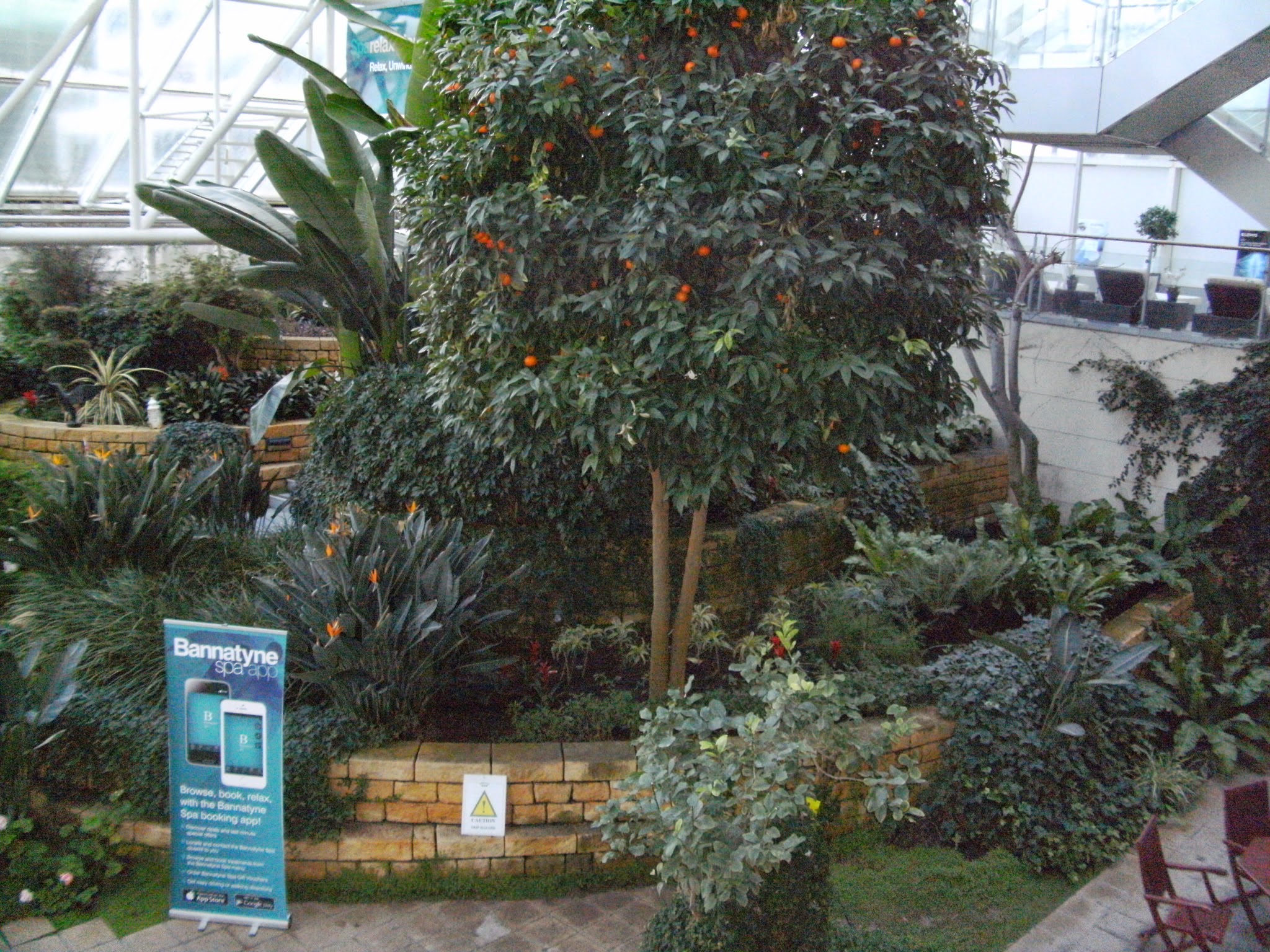
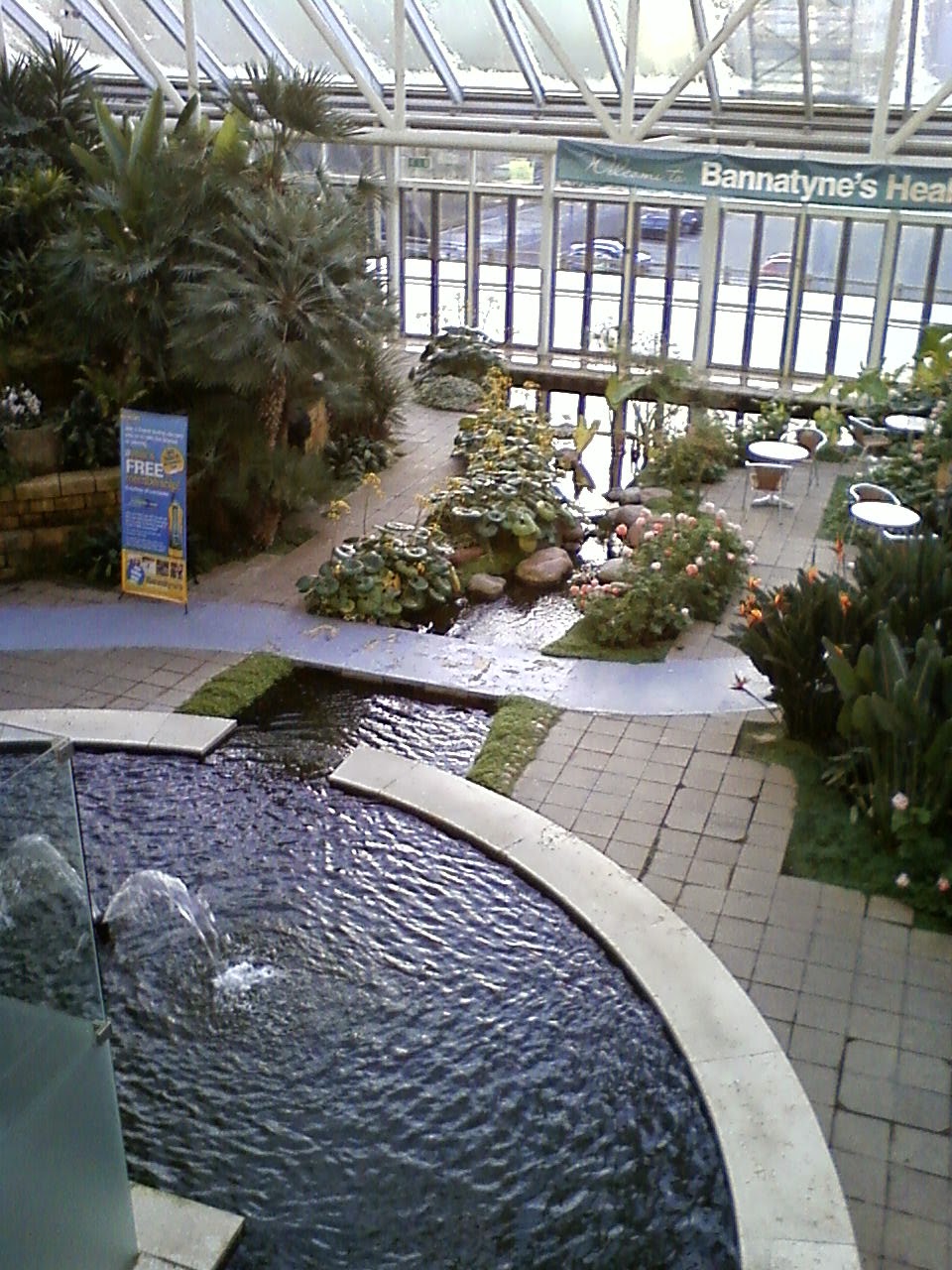
    Wow!!!!How amazing….Now head in the direction of the passageway between Encore and Subway, known as Rillaton Walk, which comes out on the south side of Midsummer Boulevard. Turn right and navigate up towards Saxon Street on the pavement running along Cresswell Lane. Keep a lookout for Midsummer Arcade, specifically the Bannatyne Health Club entrance.Turn into this and go straight through until you overlook the beautiful gardens on the floor below.

    Now look on your left and you will discover a pillar adorned with four wooden carved panels.

    The Winter Garden Panels by Jeremy Turner, Mark Adams and Christine Tacq are made from sycamore wood and are decorated in water colours.This carved wooden artwork clads an eight by four foot column within the Winter Gardens. Each of the four faces of the column is based on a theme relating to the places within the Winter Garden – the garden, the health club, the restaurant and the milk bar, which was never built.(See Historical Notes and Items of Interest)

    Backtrack to Cresswell Lane and head up towards the Shopping Centre. Just before Saxon Street and after the last commercial building, a large open area called Exchange Square springs into view. Here we find the prominent sculpture known as “The Space Between”.

    The Space Between
    The Space Between

    “The Space Between“,by Ellis O’Connell is in bronze and fibre optics and was commissioned in 1992 by Milton Keynes Development Corporation, (See Historical Notes and Items of Interest)

    .
    On the same side of Saxon Street, take the underpass and continue in a Northerly direction and the modern structure of the “The Church of Christ the Cornerstone” emerges. It’s initial feature is the dome cross which can be seen from any angle.

    Church of Christ the Cornerstone Statue
    The Church of Christ the Cornerstone

    The Church of Christ the Cornerstone was the first Ecumenical City Centre Church in the United Kingdom. It is well worthwhile stopping and having a look around inside. The chief attributes being the Cross, the Dome Stained Glass and the Altar Ensemble. These are described in some detail below. (See Historical Notes and Items of Interest)

    Moving on to the next set of sculptures could be a bit of trial. Let’s start with the easy way and that is to hug the paving of the Church and go around to the back ending up at the front of the Guild Hall. The plan is to cross the road to the opposite side to gain access to the park situated there. Sounds simple but if there are cars parked close together it becomes a mission. That being the case, it is best to turn left and meander along for a space to get through or even go to the end of the road returning on the opposite pavement. Once this is accomplished, on entering the garden sculpture 3B series No. 2 can be seen. The pathway is very bumpy, so go slowly for your own comfort. On top of this, access to this sculpture for a closer look, can only be gained by turning at the first right turn, off the pathway.

    3B series No 2: Bernard Schottlander

    3B series No 2: Bernard Schottlander.

    Now to get to the other sculptures by the same artist, back-track to the entrance path and turn right down the entrance pathway. Again another bumpy journey down the slope and another turn to the right. Travel along and just before the end, turn left and this will give access to get close up to the other two sculptures 2MS series No 4. and 3B Series No 6.

    These large brightly coloured abstract sculptures are based on simple geometric forms. Their clean lines echo cut across the verticals and horizontals of the surrounding buildings, and their strong colours contrast with the monochrome architecture. .Ironically, although Bernard Schottlander is a German, his surname literally translates into Scotsman (See Historical Notes and Items of Interest).

    Once again, backtracking is the only way out. Go back to the second path that you turned right on. Now turn left then immediately right up the slope on another bumpy path to end of the park. Cross the road and continue along the pavement to Silbury Boulevard south side. Proceed up to Saxon road underpass and turn left crossing under Silbury Boulevard. On emerging turn left and make your way a few yards down the pavement and before Norfolk House, the sculpture “Octo” is sited.

    Octo: Wendy Taylor, 1980
    Octo

    “Octo” by Wendy Taylor in 1980 encompasses stainless steel and water. “Octo’s” twisting ribbon of stainless steel makes a figure of eight. The sculpture is based on a Mobius strip, a mathematical term describing a continuous surface created by twisting a long rectangular strip through 180 degrees and joining the ends. This form does not have an inside or an outside.

    There are two other interesting art structures which have been placed by the Landscapers/Developers and consequently do not have a name. Although they are not classified by the Milton Keynes Arts Department, you may like to view them when you are in the area, The first one is on Midsummer Boulevard between Chiquita and Wetherspoons and it is a petal-like sculpture. (Pictured below)

    petal
    petal

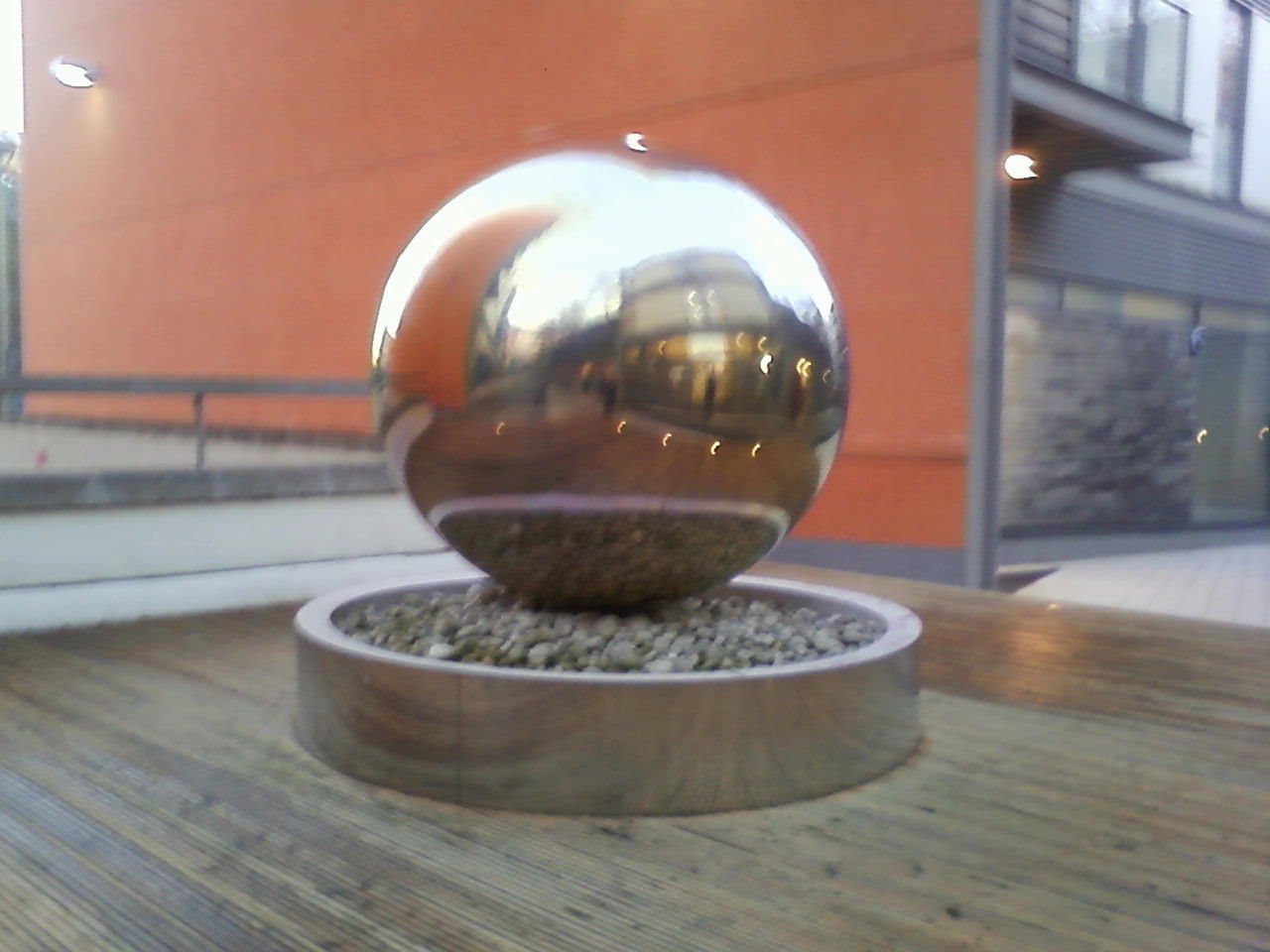
    The second one is behind Sainsbury’s where there is a pedestrian access arcade and therein stands a large unusual fountain, from which water flows from the top of a metallic sphere. This sits on gravel atop a wooden pedestal. (Pictured below) It was made in Derbyshire and commissioned in 2007. The shine on the sphere dramatically captures and reflects its surrounds.

    Sphere Fountain
    Sphere Fountain

    This concludes the Western journey and now we move on to explore the Central Section

    Historical Notes and Items of Interest : Western Section

    It is not always the artefact that impresses but the story allied and/or alluded to it.
    Burns Poem : “O Wert Thou in the Cold Blast”
    O wert thou in the cauld blast,
    On yonder lea, on yonder lea,
    My plaidie to the angry airt,
    I’d shelter thee, I’d shelter thee;
    Or did misfortune’s bitter storms,
    Around thee blaw, around thee blaw,
    They bield should be my bosom,
    To share it a’, to share it a’.
    Robert Burns
    A plaque of the poem in braille accompanies the work. Purchased following a major exhibition of Rae’s work in the city from 1995-1999.

    “Sainsbury Glass Facade”

    Mel Howse’s work in glass has sought to embrace a wide audience. Her vitreous art installations ranging from schools and places of worship, to hospitals, livery companies and a Sainsbury’s superstore, have explored all kinds of briefs in an adventurous and progressive way. Whether allied to new building design or ancient architecture, she has crossed the boundaries of both historical glazing techniques and emerging glass technology – often teaming the two.

    “Lightflow”

    Peter Freeman lives in West Cornwall on the Penwith Penninsula surrounded by water. He is continually inspired by the beautiful shifting colours that are created as sunlight is reflected between the sky and the sea.
    For “lightflow”, he wanted to express this sensory emotion of light and water using new digital LED lights, computer controls and SMS text messaging. This is the first time he has used a digital LED pixel system with SMS messaging. This has allowed him amazing control to make some really beautiful animations. The sculptures face each other diagonally across the square. In default, the light colours mirror each other, but he has also programmed the lights so that for some of the text message animations, the lights on each column are doing different things, creating an interesting dialogue of light between the sculptures across the square. This is the first time he has used a digital LED pixel system with SMS messaging.
    The Hub Milton Keynes was officially opened by HRH the Queen and Peter Freeman had the honour of demonstrating how the sculptures worked.
    For further info go to http://www.peterfreeman.co.uk/thehub.htm

    The Winter Garden Panels

    Commissioned by Livingwell Ltd to celebrate the opening, by the Duchess of York, of the Milton Keynes Winter Gardens in 1989. Christine Tacq, printmaker,was invited to design a commemorative plaque for this event. More used to small etching plates, she called Jeremy Turner in to help when told how big they wanted it to be, and that it was to be wrapped around four walls of a pillar. With the help of Mark Adams, cabinet maker, they had just less than six weeks from Christmas 1988 to 30th January, to design the panels, do all the drawing, the carving, painting and the installing. We are told that they all went home at about 4 am to get some sleep before the official opening at 11.00am on the day.
    The Duchess, possibly expecting something small, engraved and in brass, looked totally awe struck when she let the concealing curtain fall, and stared up at the eight foot high carved wood panels.

    “The Space Between”

    Eilis O’ Connell was born in Derry, N. Ireland in 1953. She studied at the Crawford School of Art, Cork. (1970 – 74), Massachusetts College of Art, Boston ( 1974-1975) and Crawford School of Art (1975-77) where she received the only award for Distinction in Sculpture that year.
    For further info go to eilisoconnell.com

    “The Church of Christ the Cornerstone”

    The Church of Christ of the Cornerstone is Britain’s first purpose-built ecumenical city church. There are covenants which bring together the Church of England, the Baptist Union, the Methodist Church, the Roman Catholic Church and the United Reformed Church, in a partnership which was seen as an important step forward for the Ecumenical movement in the UK. The church is 101 feet high while the cross rises a further 18 feet, making it the highest point in Milton Keynes. The Dome is 66 feet in diameter and nearly 40 foot high. It is half the size of the famous dome of St Paul’s Cathedral in London. The building sits on a raised plinth, the dome is finished in lead, the floors are oak and it has marbled columns. It has the unusual feature of a cascade of water over a granite wall in the baptistry. Untraditionally the altar faces south instead of east. The church has fine acoustics and is a beautiful setting to hear live music. Principally, it is a place of worship but it is also a centre for concerts, recitals, exhibitions and drama in Milton Keynes.

    City Church Cross

    The City Church Cross is the work of Alan Evans born in Stroud in Gloucestershire. Made of steel and erected in 1992, this simple cross can be viewed from 360º and consists of 8 blades wrapped together. The artist reflects the ecumenical nature of the church – ‘the coming together of different denominations, the binding together of the elements whilst still retaining their individual identity.

    Dome Stained Glass

    The Dome Stained Glass by Alexander Beleschenko, who won a competition to design and manufacture a series of architectural glass panels for this new ecumenical church in Milton Keynes. His abstract panels encircle the dome of the building incorporating focal images of a cross and the burning bush. Beleschenko says the intention of his work is ‘to uplift the spirit, to create a sense of inspiration and mystery’. Within the work is ‘a series of visual clues’ to references within the scriptures… a major symbol is water and the ceremony associated with it.’ The glass was worked in an innovative way, using a combination of techniques to modify the glass surface, making it responsive to the ever-changing lighting conditions. installed 1992.

    Altar Ensemble

    The Altar table and the Pulpit on the dais are made from polished “rosa porrino” granite. The stone was quarried in north west Spain, cut and shaped in Italy and finished and polished by specialist masons in Torquay, England. Amazingly the altar table and pulpit are capable of being moved with one hand on the dais by use of compressed air, using the hovercraft principle. There are many other Aspects and Artefacts, too numerous to mention here, but are explained and illustrated in a well constructed and comprehensive booklet obtainable from the church.

    Bernard Schottlander. (1924–1999)

    “Sculpture is the art of silence, of objects that must speak for themselves”

    Bernard Schottlander was born in Mainz, Germany in 1924 and came as a Jewish refugee to Leeds in 1939. During the war he worked in a factory as a welder, before taking a course in Sculpture at Leeds College of Art and subsequently with the help of a bursary at the Anglo-French art centre in St John’s Wood. He studied sculpture for a year in London, and his training as a welder influenced his work heavily. Bernard Schottlander described himself as a designer for interiors and a sculptor for exteriors.
    In 1963 he decided to concentrate solely on sculpture and from 1965 he taught metalwork at St Martins School.